
Busy schedules can make exercise feel like one more obligation, but an effective home workout does not need to be long, complicated, or punishing. The best routine is one that fits your space, equipment, energy, and available time well enough to repeat.
This guide shares seven practical home workout routines for beginners and busy adults in 2026. You will find low-impact cardio, strength, mobility, resistance-band, bodyweight, and dumbbell options, plus sets, repetitions, rest periods, modifications, and a sample weekly schedule. Start below your maximum effort, learn the movement patterns, and progress gradually.
How to Use These Home Workouts
Most adults can benefit from regular aerobic activity and muscle-strengthening work. The CDC’s adult physical-activity guidance and the WHO physical-activity recommendations support building toward consistent weekly activity, while recognizing that more movement is not automatically better for every person.
Use a five-minute warm-up before strength or faster cardio sessions. March in place, roll your shoulders, perform gentle hip hinges, and take easy steps side to side. During each exercise, breathe steadily and use a range of motion you can control. Rest longer when your form changes or your breathing does not settle.
Routine 1: Low-Impact Cardio Ladder
This routine raises your heart rate without jumping. It is useful for beginners, apartment living, recovery days, or anyone who prefers a lower-impact starting point.
How to do it
- March in place for 2 minutes.
- Step side to side for 60 seconds.
- Perform alternating knee lifts for 60 seconds.
- Walk forward and backward in a clear space for 2 minutes.
- Repeat the sequence 2 to 4 times.
Effort: Keep a pace at which you can speak in short sentences. Rest: Take 60 to 90 seconds between rounds. Modification: Hold a chair or reduce the range of each step. To progress, add one round or slightly increase the pace before adding impact.
Routine 2: Chair-Assisted Strength Circuit
A sturdy chair can provide balance support while you learn basic strength patterns. Place it on a non-slip surface and make sure it does not roll.
Exercises
| Exercise | Sets and reps | Rest | Beginner modification |
|---|---|---|---|
| Chair squat | 2–3 sets of 8–12 | 60–90 sec | Use a higher seat or reduce depth |
| Incline push-up | 2–3 sets of 6–10 | 60–90 sec | Use a wall instead of a chair |
| Supported reverse lunge | 2 sets of 6–8 per side | 60–90 sec | Tap one foot back without lowering far |
| Calf raise | 2 sets of 10–15 | 45–60 sec | Hold the chair with both hands |
Move slowly enough to keep your knees tracking in line with your feet. Keep your ribs stacked over your pelvis instead of arching your back. Complete one set of each exercise, rest, and repeat the circuit.
Routine 3: Resistance-Band Full-Body Circuit
Resistance bands are compact and versatile. Inspect the band before use, keep it away from sharp edges, and follow the manufacturer’s instructions for anchors. This routine trains pushing, pulling, squatting, and hip extension.
Complete 2–3 rounds
- Band row: 10–15 repetitions. Keep your shoulders down and pull your elbows toward your ribs.
- Band chest press: 8–12 repetitions. Anchor the band securely behind you or use a safe setup designed for the band.
- Band squat: 10–12 repetitions. Keep tension controlled and avoid letting the band snap back.
- Band hip hinge: 10–12 repetitions. Push your hips back, keep your spine neutral, and stand tall.
Rest 60–90 seconds between rounds. Use a lighter band, reduce repetitions, or perform the movements without resistance while learning. Progress by increasing control, using a stronger band, or adding one repetition at a time.
Routine 4: Bodyweight Push, Pull, and Core
This bodyweight session works well when you have no equipment. It focuses on controlled movement rather than speed.
Complete 2–3 rounds
- Wall or incline push-up: 6–12 repetitions.
- Prone back extension or standing wall slide: 8–12 repetitions.
- Glute bridge: 10–15 repetitions.
- Dead bug: 6–10 repetitions per side.
- Side plank from knees: 15–25 seconds per side.
Rest 45–75 seconds between exercises as needed. A wall push-up is easier than an incline push-up; a bent-knee dead bug is easier than extending both legs. Stop a repetition before your lower back arches or your shoulders shrug.
Routine 5: Eight-Minute Mobility Reset
Mobility work can help you move comfortably through daily tasks and prepare for other training. It should feel controlled and gentle, not like forcing a stretch.
Flow
- Cat-cow or standing spine flexion and extension for 6 slow repetitions.
- Hip-hinge practice for 8 repetitions.
- Half-kneeling hip-flexor stretch for 30 seconds per side.
- Open-book rotation for 6 repetitions per side.
- Supported deep-breathing squat hold or seated ankle mobility for 30 seconds.
Repeat the flow once or twice. Use a wall or chair for balance. If kneeling is uncomfortable, perform the hip-flexor movement standing with one foot on a low step. Mobility should not cause sharp pain, numbness, or joint instability.
Routine 6: Ten-Minute Movement Snack
Short sessions can be useful when meetings, commuting, family care, or fatigue make a full workout unrealistic. Set a timer for 10 minutes and work at a steady pace.
Perform five rounds
- 30 seconds of brisk marching or walking.
- 8 chair squats.
- 6 wall push-ups.
- 8 alternating step-backs.
- 20 seconds of relaxed breathing.
Rest only as needed, but do not rush. If 10 minutes is too much, complete two or three rounds and stop while you still feel capable. If it feels easy after several sessions, add a sixth round or use a slightly faster marching pace.
Routine 7: Beginner Dumbbell Full Body
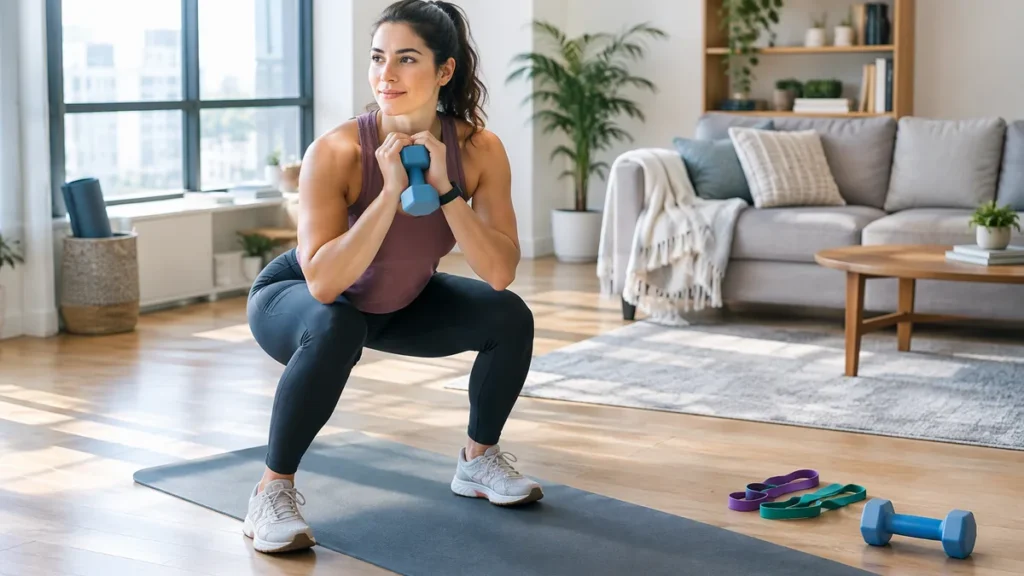
One light or moderate dumbbell can train several patterns. Choose a load that allows you to finish every repetition with stable posture and at least two comfortable repetitions left in reserve.
Complete 2–3 sets
| Exercise | Repetitions | Rest | Key cue |
|---|---|---|---|
| Goblet squat | 8–12 | 75–120 sec | Keep the weight close to your chest |
| Supported one-arm row | 8–12 per side | 60–90 sec | Pull toward your hip |
| Dumbbell floor press | 8–12 | 60–90 sec | Keep wrists stacked over elbows |
| Suitcase carry | 20–40 sec per side | 60 sec | Walk tall without leaning |
Use a lighter object or no weight while practicing. For the floor press, keep the movement comfortable and avoid forcing your elbows below the floor. Put the weight down carefully and keep your workout area clear.
Sample Weekly Schedule for Busy Adults
The schedule below combines strength, cardio, and mobility while leaving recovery time. Move the days around your calendar; consistency matters more than a perfect Monday-to-Sunday pattern.
| Day | Session | Time |
|---|---|---|
| Monday | Chair-assisted strength circuit | 20–25 minutes |
| Tuesday | Low-impact cardio ladder | 15–25 minutes |
| Wednesday | Mobility reset or easy walk | 8–20 minutes |
| Thursday | Resistance-band circuit | 20–30 minutes |
| Friday | Movement snack | 10 minutes |
| Saturday | Dumbbell full body or outdoor walk | 20–35 minutes |
| Sunday | Rest, gentle mobility, or normal daily movement | Optional |
If you are new to exercise, begin with three sessions in the first week: one cardio, one strength, and one mobility session. Add time or another session only after your body is responding well.
Beginner Safety Advice
- Clear your workout area and check that chairs, bands, and weights are stable.
- Warm up gradually and keep the first set easier than the later sets.
- Use controlled repetitions instead of chasing speed or exhaustion.
- Stop for chest pain, faintness, unusual shortness of breath, severe pain, or new neurological symptoms.
- If you have a chronic condition, recent injury, pregnancy, balance concerns, or take medication affected by exercise, ask a qualified clinician how to modify your plan.
- Do not treat a watch, tracker, or calorie estimate as a diagnosis or permission to ignore symptoms.
How to Progress Without Overdoing It
Change one variable at a time. You might add two repetitions, one round, five minutes of walking, a small amount of resistance, or slightly more rest between sessions. Keep a simple log of the exercise, sets, repetitions, and how it felt. If soreness lasts several days, your joints hurt, or your normal energy drops sharply, reduce the workload and reassess.
For equipment ideas, see HealthyGlob’s beginner home workout equipment guide. For broader daily habits, read 12 Essential Daily Health Habits for a Healthier Life in 2026. If weight management is one of your goals, you can also review 15 science-backed ways to lose weight naturally and use the HealthyGlob adult BMI Calculator as a screening tool, not a diagnosis.
Conclusion
Innovative home workouts do not need unusual equipment or complicated choreography. The innovation can be the way you fit movement into real life: a 10-minute session between tasks, a chair-supported circuit, a band routine in a small room, or a mobility reset before bed. Choose one routine that feels realistic, practice it for two weeks, and progress only when the basics feel stable.
Fitness disclaimer: This article is for general education and is not personalized medical advice, diagnosis, or treatment. Exercise needs vary by age, fitness level, health conditions, injuries, pregnancy status, and medications. Consult a qualified healthcare professional before beginning a new exercise program if you have concerns, and seek urgent medical care for emergency symptoms.
Sources: CDC Physical Activity Basics, WHO Physical Activity Fact Sheet, and Physical Activity Guidelines for Americans.