
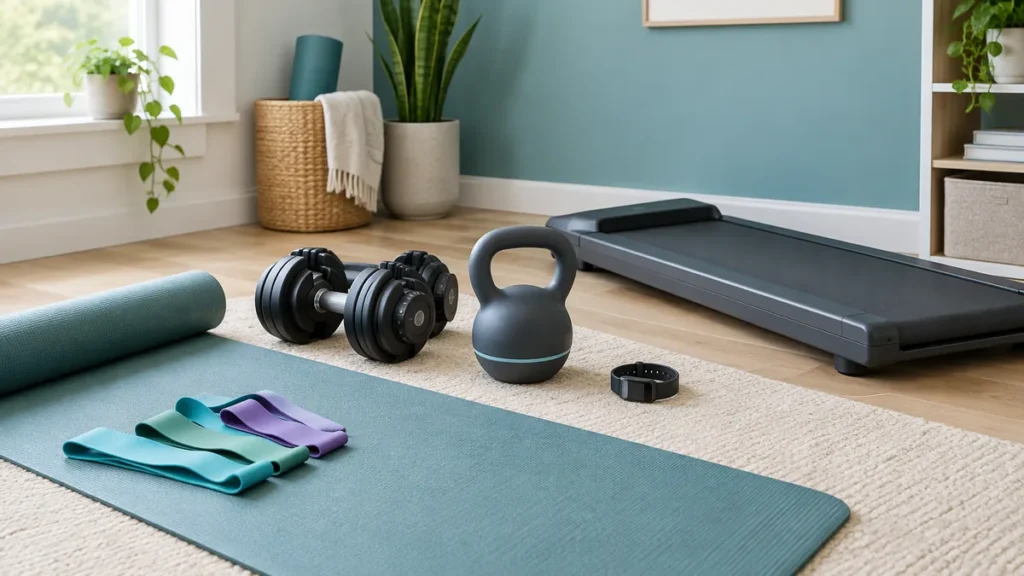
Choosing the best home workout equipment for beginners in 2026 does not mean buying every device in a fitness store. The most useful setup is usually a small collection of versatile tools that fit your space, budget, comfort level, and actual routine. A yoga mat can support mobility work, resistance bands can add challenge without taking much room, and adjustable weights can grow with your strength.
This guide compares six beginner-friendly equipment categories: yoga mats, resistance bands, adjustable dumbbells, kettlebells, walking pads, and fitness trackers. It focuses on what each tool does, who it suits, what to check before buying, and how to combine simple equipment into a safe starting plan. It does not promote a specific brand, invent prices, or rely on unverified reviews.
In this guide
Quick comparison: beginner home workout equipment
| Equipment | Best for | Main advantage | Check before buying |
|---|---|---|---|
| Yoga mat | Mobility, floor exercises, stretching | Comfort and grip | Thickness, texture, size, easy cleaning |
| Resistance bands | Strength, warm-ups, travel | Lightweight and portable | Band type, resistance range, handles, anchor safety |
| Adjustable dumbbells | Progressive strength training | Multiple loads in one set | Adjustment mechanism, storage, secure plates |
| Kettlebell | Hinges, carries, full-body drills | Simple, compact training tool | Comfortable handle and manageable starting load |
| Walking pad | Indoor walking and movement breaks | Convenience in small spaces | Deck size, noise, stability, safety controls |
| Fitness tracker | Activity awareness and routine tracking | Feedback and reminders | Comfort, battery, privacy, measurement limits |
These categories serve different purposes. A mat and bands can create a low-cost foundation, while adjustable dumbbells or a kettlebell make progressive resistance easier. A walking pad can support indoor movement, and a tracker can help you notice patterns. None of them is required for every beginner.
What should a beginner buy first?
Start with the equipment that solves your most immediate barrier. If hard floors make floor exercises uncomfortable, choose a mat. If you want quiet strength work in a small apartment, consider bands. If your goal is to build strength and you have safe storage space, adjustable dumbbells may provide more long-term loading options than several fixed-weight pairs.
Use the “minimum effective setup” test: can you name three or four exercises you will perform with the item this month? If not, wait. A product that stays in a box is not a fitness investment, regardless of how advanced it looks.
The best home workout equipment for beginners
1. Yoga mats: the useful foundation
A yoga mat creates a defined surface for mobility work, body-weight strength exercises, stretching, and floor-based core training. Beginners often benefit from a surface that is stable, comfortable, and easy to clean rather than from a specialized performance material.
Look for enough cushioning for your knees and wrists without so much softness that balance becomes difficult. A textured, non-slip surface can help, but grip depends on sweat, flooring, and cleaning. Check the mat’s length and width if you are tall or plan to do movements that require more space. Store it dry and clean it according to the manufacturer’s instructions.
2. Resistance bands: portable, versatile resistance
Resistance bands can support rows, presses, squats, hip exercises, shoulder warm-ups, and mobility drills. They are especially useful for beginners who want a compact setup or who travel. Long loop bands are versatile for lower-body and full-body movements; smaller loop bands can be useful for hips and glutes; tube bands with handles may feel familiar for pressing and pulling.
Resistance increases as a band stretches, so the challenge is not identical to a dumbbell’s constant load. Inspect bands for cracks, thinning, or damage before each use. If you anchor a band in a door or around furniture, use an appropriate anchor and follow its instructions. Keep the band away from sharp edges and never aim a released band toward your face.
3. Adjustable dumbbells: efficient progressive strength
Adjustable dumbbells combine several weight options in one compact system. They can support presses, rows, squats, lunges, deadlifts, carries, and many other basic exercises. For beginners, their main value is progression: as a movement becomes easier, you may be able to increase the load in small steps.
Compare how the adjustment mechanism works, how securely the plates or blocks lock, and whether the handles remain comfortable. A quick-change system can save time, while a plate-loaded system may offer a different storage and durability tradeoff. Keep the weights on a stable surface and give yourself clear floor space before lifting.
4. Kettlebells: simple full-body training
A kettlebell can be used for deadlift patterns, goblet squats, carries, presses, rows, and controlled swings after you learn the movement. The offset handle changes how the load sits in your hand, which makes technique important. Beginners should first learn the hip hinge and practice controlled repetitions before attempting faster ballistic movements.
Choose a starting weight that lets you maintain a neutral spine and controlled breathing. The handle should feel smooth without sharp edges. Use a firm, uncluttered surface and avoid swinging a kettlebell near furniture, children, pets, or other people. A qualified coach can help if you are unsure how to learn swings safely.
5. Walking pads: convenient indoor movement
A walking pad is a compact treadmill-style device designed primarily for walking. It can make movement more convenient when weather, neighborhood safety, work schedules, or limited outdoor access are barriers. A walking pad is not automatically better than outdoor walking; its value is that it may reduce friction and make regular movement easier.
Check the walking surface, handrail configuration if included, maximum user weight, speed controls, emergency stop features, noise, storage method, and warranty. Place it on a stable, level surface with clear space around it. Keep cords away from walkways, and do not use the device while distracted by tasks that reduce your awareness of balance or speed.
6. Fitness trackers: feedback, not a diagnosis
Fitness trackers can record activity trends, reminders, workouts, and sometimes heart-rate or sleep-related estimates. Their best beginner use is behavioral awareness: noticing whether you walk more on certain days, how often you complete planned sessions, or whether reminders help you take movement breaks.
Tracker measurements are estimates and can vary with fit, motion, skin contact, device design, and software. Treat them as feedback rather than as medical measurements or a reason to ignore symptoms. Review privacy settings before connecting an app, and choose a device you will comfortably wear and charge. If a tracker creates anxiety or encourages unsafe exercise, stop using that feature.
Buying advice for 2026
Match equipment to your routine
Write down when and where you will use the equipment. A compact item that supports a 20-minute routine three times per week may be more valuable than a large machine used once. Think about storage, noise, flooring, pets, children, and whether you rent your home.
Prioritize adjustability and versatility
For many beginners, one adjustable tool can replace several single-purpose products. Bands with different resistance levels, adjustable dumbbells, and a mat can cover a wide variety of training needs. Versatility matters most when it does not make setup so complicated that you avoid using the equipment.
Check safety and return information
Read the manufacturer’s instructions, weight limits, assembly guidance, cleaning requirements, and warranty. For powered equipment, check emergency stops, electrical requirements, noise information, and whether replacement parts are available. Avoid buying any product whose safety instructions are unclear.
Do not confuse technology with results
Connected apps, screens, and notifications can be useful, but they are not a substitute for consistent movement and progressive practice. Choose technology only when it solves a problem you actually have. A simple tool you use regularly is usually a stronger starting point than a complicated tool you rarely open.
A simple beginner home workout plan
This three-day plan uses a mat, bands, and one light-to-moderate resistance option. Move slowly, stop if you feel sharp pain, and leave at least one recovery day between strength sessions.
- Day 1: Full body. Warm up with five minutes of easy movement. Complete two rounds of eight to 12 chair squats, eight to 12 band rows, eight to 12 incline push-ups against a stable surface, and a comfortable 20- to 30-second plank or dead-bug variation.
- Day 2: Walking and mobility. Walk outdoors or on a walking pad at an easy-to-moderate pace. Finish with gentle hip, calf, chest, and upper-back mobility.
- Day 3: Rest or light movement. Take a short walk, stretch gently, or do normal daily activities without forcing a workout.
- Day 4: Full body. Practice a hip hinge with no weight, then complete two rounds of a light deadlift pattern, band chest press, supported split squat, and suitcase carry with a manageable dumbbell or kettlebell.
- Day 5: Easy cardio. Walk at a pace that allows conversation. Keep the session comfortable enough to repeat.
- Days 6 and 7: Review and recover. Choose rest or light movement. Note which exercises felt stable, which need instruction, and what you can repeat next week.
Federal physical-activity guidance encourages adults to work toward regular moderate-intensity aerobic activity and muscle-strengthening activity on at least two days per week, when appropriate for their health. Beginners can build toward that level gradually rather than forcing it in the first week.
Frequently asked questions
Do I need all six types of equipment?
No. A mat, bands, or one pair of manageable weights may be enough to begin. Add equipment only when it solves a specific training or convenience problem.
Are adjustable dumbbells better than a kettlebell?
They serve different purposes. Adjustable dumbbells offer more loading and exercise options, while a kettlebell is compact and useful for carries, squats, hinges, and presses. Choose based on your space, technique, and preferred movements.
Is a walking pad safe for beginners?
It can be, when used on a stable surface with clear space, appropriate speed, and the manufacturer’s safety features. Begin slowly and avoid multitasking if it reduces your awareness of balance or surroundings.
Can resistance bands build strength?
Resistance bands can make exercises more challenging and can support strength training. Progress by using a stronger band, increasing control, adding repetitions within a reasonable range, or choosing a more difficult variation.
Are fitness tracker calories accurate?
Calorie-burn estimates are not precise enough to treat as an exact food budget or medical measurement. Use a tracker to observe trends and support routines, not to justify extreme restriction or ignore how you feel.
What should I buy if I have very little space?
Start with a foldable mat, a small set of loop or tube bands, and possibly one adjustable weight. A walking pad can be useful if indoor walking is a priority, but measure storage space and check noise and clearance first.
Conclusion
The best home workout equipment for beginners in 2026 is the equipment that fits your home and supports a routine you can repeat. A mat can make movement more comfortable, bands and weights can support progressive strength, a walking pad can reduce barriers to walking, and a tracker can provide useful feedback. Start with one or two tools, learn the basics, and add equipment only when your routine shows you what is missing.
Sources and safety notes
This guide provides general education and is not personalized medical advice. Talk with a qualified healthcare professional before beginning a new exercise program if you have a chronic condition, recent injury, balance concerns, chest pain, unexplained shortness of breath, or other symptoms. Stop exercising and seek medical guidance for concerning symptoms.
- CDC: Physical Activity Basics and Guidelines for Adults
- Physical Activity Guidelines for Americans, 2nd edition
- FDA: General Wellness Products
HealthyGlob reminder: Choose the simplest setup that helps you move consistently, safely, and with confidence.